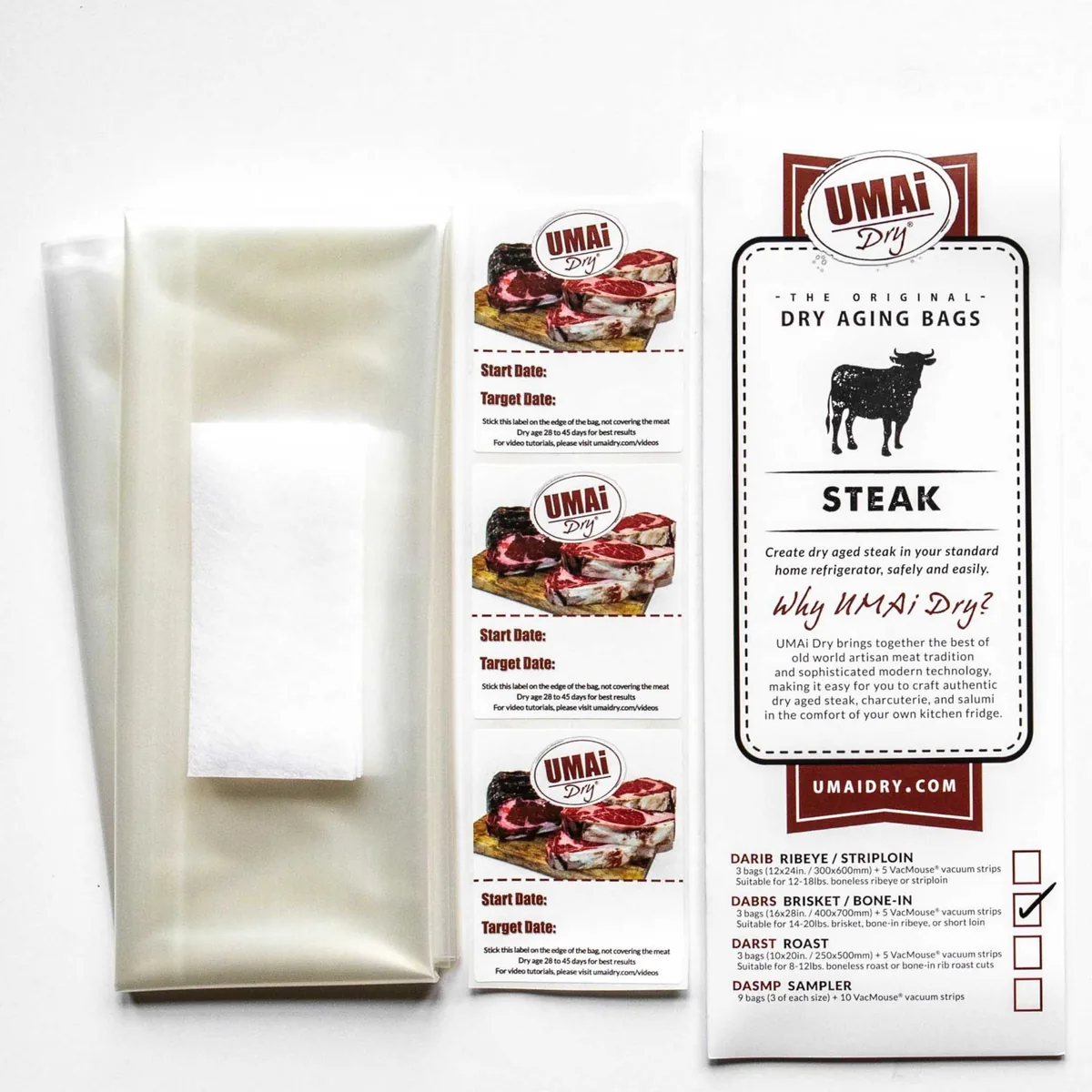
UMAi Dry Dry Aging Bags Roast dry-aging bagsDry-aging bags~$26

UMAi Dry

UMAi Dry Dry Aging Bags Roast

~$8.67 per bag

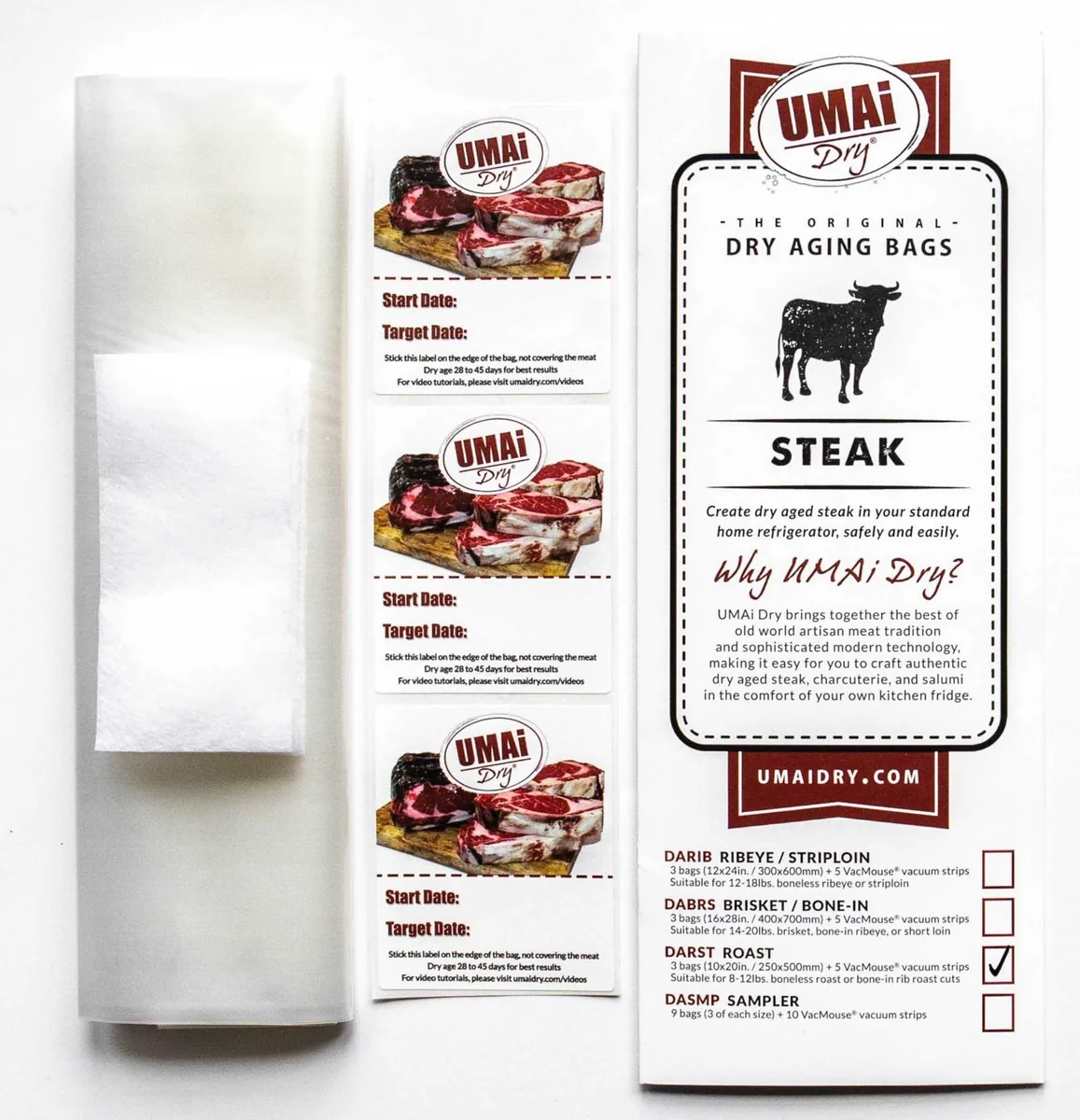
The smallest UMAi steak bag, 10 x 20 in, sized for a boneless roast or a 2- to 3-bone rib roast of roughly 8-12 lb. It uses the same breathable membrane and fridge method as the Ribeye/Striploin packet, just for a shorter cut. Three bags and five VacMouse strips come in the packet.

Approx. price

~$26

maker's list price, not a live price

Price per bag

~$8.67

pack price ÷ bags

Largest cut

12 lb

what the maker sizes the bag for

Vacuum sealer

recommended

Best for: Someone aging a holiday rib roast rather than a whole subprimal

Using the bags

Sealing:
Vacuum sealer recommended, per UMAi Dry.
UMAi Dry says:
UMAi: seal with 'either vacuum sealer or immersion sealing method', then rest 'on open wire rack in a regularly used modern frost free kitchen refrigerator located in a room temperature environment for 4-6 weeks'; product pages say 28 to 45 days. Small bag 10 x 20 in (250 x 500 mm); 'Suitable for about 8-12 lbs'; sized for a boneless roast or 2-3 bone rib roast.

Bags go in an ordinary refrigerator, so the fridge sets the temperature. Bags against a cabinet

Specifications

Approx. price
~$26 (3-bag packet, $26.00 on umaidry.com)
Type
Dry-aging bags
Price per bag
~$8.67 per bag
Vacuum sealer
Vacuum sealer recommended
Ages
beef

Features, per UMAi Dry

  • 3 Small bags, 10 x 20 in (250 x 500 mm)
  • For boneless roasts or 2-3 bone rib roasts
  • About 8-12 lb per bag
  • 5 VacMouse strips for channel-type sealers
  • Ages in a frost-free fridge

Where the specs put it ahead

  • Sized for a 2-3 bone rib roast without excess bag
  • Lowest per-bag cost of the UMAi retail packets
  • Same fridge-only method, no cabinet
  • VacMouse strips included

What it gives up

  • Too small for a full striploin or ribeye subprimal
  • Smaller cuts lose a larger share to trimming after aging
  • Frost-free fridge required

The two lists above are drawn from the maker’s own pages and prices, not from owner reports. Where owner discussion has been read it appears in its own section below, so the two are never mistaken for each other.

What owners say

From what 14 owners described in owner discussions between February 2020 and June 2026. Owners rarely say which UMAi bag size they used, so these are reports from owners aging smaller cuts (about 3 to 10 lb) in UMAi bags, the range this size is made for. Reports on whole subprimals are on the Ribeye/Striploin page.

Most of what owners report about smaller roasts is about loss. A 5 lb ribeye ended at about half its weight after 28 days and trimming, and a 7.75 lb cut lost about 55% over 80 days before trim.

Length matters more than with a whole loin. One owner judged 45 days too long for a 3 lb rib roast, and a 4 lb tri tip aged 40 days came out very dry; at the other end, the owner of a 5 lb ribeye tasted no difference at 28 days. A 10 lb ribeye taken past 50 days was a complete success for one owner.

Owners who want to try different ages from one purchase have halved a large cut into two bags, which is a practical use for the smaller size. Otherwise, owners who got poor results from small cuts often blame the cut rather than the bag.
What owners like

  • A 10 lb ribeye is enough: one owner called a 50-plus-day age on one a complete success and cut four large steaks from it
  • Lets you split a big cut and compare ages: one owner halved a 16 lb boneless ribeye into two bags and pulled the smaller piece at 48 days while the other kept going, and another split a brisket the same way
  • The bag keeps the smell close: on a 5 lb boneless ribeye two weeks in, one owner could only pick up a faint cheese-like odor with a nose pressed to the bag

Common complaints

  • Small cuts lose a lot. One owner's 5 lb ribeye lost almost 25% in 28 days and ended at about half its starting weight after trimming, and a 7.75 lb cut aged 80 days lost about 55% before any trim
  • Lean or thin cuts can dry out: a 4 lb tri tip aged 40 days needed heavy trimming and came out very dry, though its flavor was funky and not bad
  • Ages that suit a whole loin can be too long here. One owner thinks 45 days was too long for a 3 lb rib roast, which lost a lot of moisture and got more funk than wanted; another blames a smaller cut for a 72-day roast that came out dried out
  • Short ages on a modest cut can be underwhelming: the owner of the 5 lb ribeye tasted no difference after 28 days, one owner's 7 lb boneless ribeye was less than amazing, and another rated a small-cut age good but not great
  • Firm, chewy steaks turn up too: one owner's 9 lb striploin was tough to cut and chew after 64 days, and another found bag-aged meat chewier than a plain salted steak
  • A seal can fail mid-age: one owner's bag ripped while flipping a 9 lb New York strip at day 30 and could not be resealed

Questions owners ask about the UMAi Dry Dry Aging Bags Roast

Is a small roast worth dry aging in a bag?

Results are mixed for cuts of 5 lb or less. One 5 lb ribeye tasted no different at 28 days and lost half its weight by the end, and a 4 lb tri tip came out very dry at 40 days. A 10 lb ribeye taken past 50 days worked well for one owner.

How long should a smaller roast age?

Shorter than a whole loin, in owners' experience: one owner thinks 45 days was too long for a 3 lb rib roast. The owner of a 72-day roast that came out dried out suspects a smaller cut makes long ages riskier.

Can I split one big cut into two bags?

Owners have. One halved a 16 lb boneless ribeye into two bags to pull one piece at 48 days and leave the other longer, and another split a brisket into two bags for a 40-day age.

Will a small cut in a UMAi bag smell?

Not much, for one owner: two weeks into a 5 lb boneless ribeye, a faint cheese-like smell was only noticeable with a nose right against the bag.

Others in the same part of the catalog

More from UMAi Dry →

← Back to the catalog